By Amanda Hoglund August 17, 2026
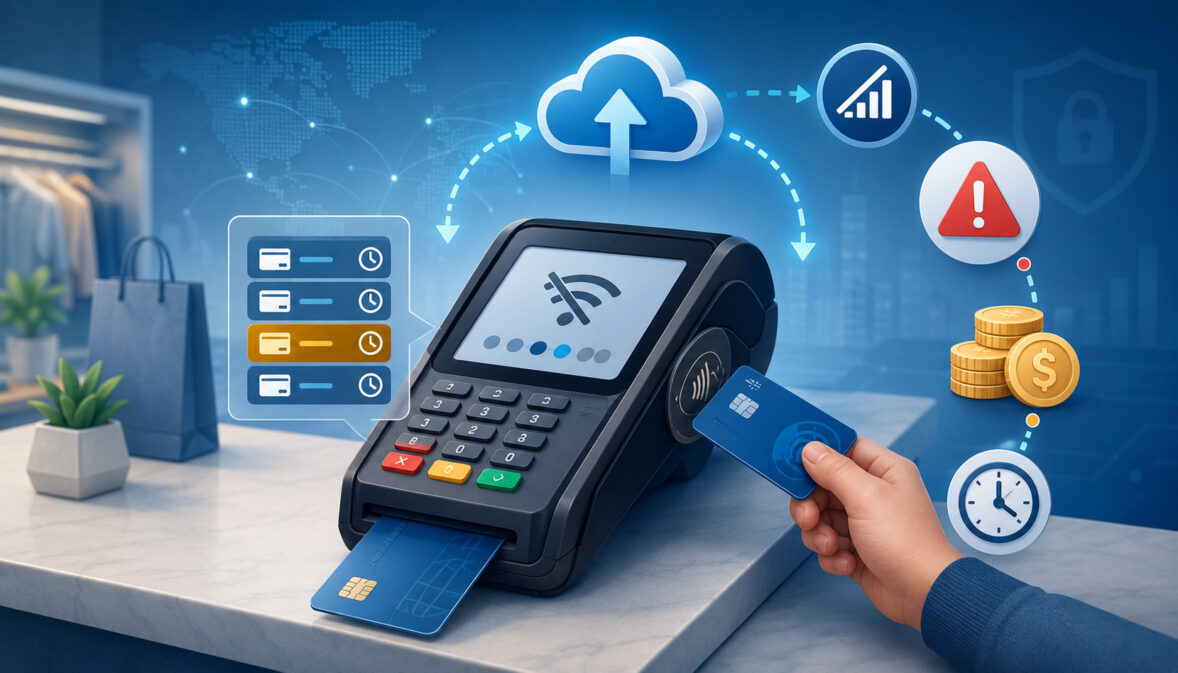
When a terminal loses connectivity, some payment systems can temporarily store transactions instead of stopping sales—but the merchant may be accepting financial risk because the issuer has not necessarily approved those transactions yet.
That tradeoff is the heart of store-and-forward payment processing. A merchant can keep a checkout line moving during a payment terminal network outage, continue taking payments at an outdoor event with weak cellular service, or let a field technician complete a sale where coverage is intermittent.
But continuity comes with conditions: the transaction may not reach the issuer until later, and a customer may already have the goods or services before the merchant learns that payment was declined.
A payment terminal offline mode should therefore be treated as a controlled business-continuity feature, not a substitute for normal online authorization.
What a terminal can store, how much exposure is allowed, which cards qualify, how transactions are secured, how quickly they must be uploaded, and who absorbs a later loss can vary by terminal, processor, acquirer, payment network, transaction type, merchant category, card type, and merchant-specific risk configuration.
The distinction matters because several different payment mechanisms are casually described as “offline.” A terminal can store a transaction for later transmission. An EMV card and terminal may perform limited offline decisioning when their capabilities and parameters permit it.
A processor may support deferred authorization. A network may also have resiliency mechanisms elsewhere in the authorization chain. These are related concepts, but they are not interchangeable.
EMVCo’s specifications, for example, define capabilities for chip acceptance and terminal/card interaction, while payment networks separately maintain authorization and processing requirements.
The safest operational rule is simple: a transaction that has merely been stored is not necessarily guaranteed payment.
What Is Store-and-Forward Payment Processing?
Store-and-forward payment processing is a payment workflow in which an eligible transaction is captured while normal communications are unavailable, stored temporarily in an approved terminal or payment application, and transmitted after connectivity returns.
In an ordinary connected transaction, a terminal typically sends an authorization request through the processor or acquirer and payment network to the issuer. The issuer evaluates the account and transaction and returns an approval or decline.
With store and forward transactions, that online exchange may be delayed because the payment terminal connection loss prevents the request from reaching the normal authorization path.
Visa describes deferred authorization as a situation in which a merchant cannot complete authorization at the time of the transaction because of connectivity, system problems, or other limitations and submits the authorization later. That definition illustrates why merchants should separate “we accepted the transaction locally” from “the issuer approved the transaction.”
Implementation varies considerably. Some terminals maintain an encrypted terminal transaction queue. Some POS applications manage the queue. Other systems require explicit processor configuration before any offline credit card processing is permitted.
A merchant should never assume that a terminal can safely enter offline mode simply because the hardware has enough memory to hold transaction records.
For broader background on terminal connectivity and transaction flow, see Payment Terminals 101, which discusses Ethernet, Wi-Fi, cellular connectivity, EMV, and contactless acceptance.
Store-and-Forward vs. Normal Online Authorization
The difference between online and offline processing is not simply whether the terminal has an internet connection. The key question is when authorization happens and what the merchant knows when the customer leaves.
| Feature | Normal Online Authorization | Store-and-Forward |
| Issuer contacted immediately | Normally yes | Not necessarily |
| Approval known at checkout | Usually yes | May not be |
| Transaction stored locally | Usually only as part of normal records | Often temporarily queued |
| Decline may occur later | Less commonly for initial authorization | Yes, where authorization is deferred |
| Merchant financial exposure | Lower when valid authorization is obtained | Potentially higher |
| Settlement timing | Follows normal processing cycle | May be delayed until upload succeeds |
Authorization, capture, clearing, settlement, and funding also need to remain separate concepts. Authorization is the decision about whether the payment request may proceed. Capture records the transaction for submission. Clearing exchanges transaction information through the payment system.
Settlement handles the financial obligations between participating institutions, while funding is when the merchant ultimately receives proceeds under its merchant agreement. Visa’s current public rules separately address authorization, clearing, settlement, reversals, and transaction-processing requirements.
A stored transaction has not necessarily completed that chain. Even if the POS prints a receipt or marks the local sale complete, the payment record may still need to be uploaded and authorized.
Merchants evaluating hardware should also understand the difference between the POS application and the payment device itself. The guide to fully integrated and semi-integrated terminals provides useful context on how terminals can interact with POS systems and payment applications.
Offline Mode vs. Offline Authorization
“Offline mode” is one of the most confusing expressions in payment operations because different vendors use it for different functions.
A terminal offline mode can mean that the device accepts transaction data locally while communication with the processor is unavailable. The record sits in a secure queue and is transmitted later. In that situation, the terminal may not have received any issuer authorization at checkout.
Offline authorization, by contrast, can refer to payment decisioning that occurs without obtaining a real-time response from the issuer.
EMV contact-chip technology supports interactions between the card and terminal that depend on terminal capabilities, card parameters, application configuration, cardholder-verification methods, and issuer rules.
EMVCo maintains the specifications and approval framework for those components, but a merchant should not assume that every EMV transaction can be approved offline simply because the card contains a chip.
A third concept is deferred payment authorization. Here, authorization that normally would have occurred during the transaction is submitted later. Visa’s documented deferred-authorization process is an example of a network-defined mechanism for transactions that could not be authorized when the cardholder was present.
Mastercard’s current Transaction Processing Rules likewise include specific provisions covering final and deferred authorizations, demonstrating that network requirements exist at a more detailed level than a terminal’s generic “offline” label.
These mechanisms should never be treated as automatic equivalents:
- Offline storage: transaction information is held for later transmission.
- Deferred authorization: an authorization request is submitted later.
- EMV offline decisioning: card and terminal logic may reach certain outcomes locally where supported.
- Online authorization: an issuer or authorized network service responds during the transaction.
- Settlement: financial processing occurs later after the transaction has entered the appropriate processing flow.
How a Store-and-Forward Transaction Works

A typical store-and-forward workflow can be summarized in nine steps:
- The terminal detects a card payment connectivity failure.
- The payment application determines whether approved offline functionality is available.
- The transaction is checked against configured eligibility and risk controls.
- The merchant accepts an eligible transaction.
- Required transaction information is securely stored in the approved device or application.
- Connectivity returns.
- The terminal or application transmits the pending transaction.
- The authorization or subsequent processing response is received, which may include approval, decline, duplicate, or failure status.
- Successfully processed transactions continue toward clearing, settlement, and merchant funding.
The exact flow can differ substantially. Some systems automatically reconnect and upload payments. Others require an operator to confirm a pending transaction upload or review an exception queue.
Some will retry communication failures but will not retry a true issuer decline. Merchants should follow processor-approved procedures instead of experimenting with hidden menus, resets, service codes, or unsupported configuration changes.
The distinction between a connectivity outage and a processor or network outage also matters. If one Wi-Fi connection fails, cellular service may still be available. If the processor’s host is unavailable, simply switching internet connections may not solve the problem.
A terminal’s local display also deserves careful interpretation. Labels such as “stored,” “pending,” “accepted,” or similar messages are product-specific. Staff should not translate them into “issuer approved” unless the processor’s documentation clearly says an actual authorization occurred.
Is an Offline Transaction Actually Approved?
Not necessarily.
A transaction may be locally accepted and stored even though the issuer has not yet seen it. That means a receipt, completed POS order, or local “success” message is not automatically evidence of issuer approval.
This creates an important operational difference between real-time authorization and delayed payment authorization. During a normal online transaction, the issuer can consider factors such as account status, available credit or funds, card restrictions, fraud signals, and other authorization controls before the merchant releases the goods.
When authorization is postponed, that decision happens after the merchant has already accepted the commercial risk.
A stored transaction can therefore become an offline payment decline after upload. Possible causes include insufficient funds or credit, an account restriction, a credential that is no longer valid, the card being reported lost or stolen, fraud controls, issuer risk policies, transaction limits, duplicate detection, token status, or another network or processor rule.
Not every deferred transaction will decline, of course. The risk depends on the merchant’s customers, ticket size, transaction type, configuration, outage duration, and other factors. But merchants should manage the queue as unresolved payment exposure until they have confirmation of successful processing.
That is why customer-facing language matters. Employees should avoid saying, “Your card was approved,” when the terminal has merely stored the payment request.
Why Offline Transactions Can Decline Later
The most important economic fact about offline payment processing is that a merchant can deliver value before payment certainty exists.
Imagine a festival vendor sells an item and the terminal stores the transaction because cellular service is unavailable. Two hours later the terminal reconnects. The issuer then declines the request. The customer may already have left the venue, and the merchant may have no practical way to collect the amount.
Reasons for a later decline can include:
- insufficient available funds or credit;
- a closed, restricted, or otherwise unavailable account;
- a card subsequently reported lost or stolen;
- issuer fraud controls;
- an expired or invalid credential;
- card or transaction restrictions;
- a deactivated token or credential;
- duplicate detection;
- processor or network validation rules;
- transaction-type restrictions;
- other issuer authorization decisions.
Visa has specifically documented that delays can create complications in deferred authorization, including situations involving payment tokens whose status changes before the authorization request arrives.
This is why decline risk on upload should influence the merchant’s offline limits. A convenience store accepting a routine low-value purchase has a very different risk profile from a jewelry retailer releasing an expensive item.
| Scenario | Offline Suitability | Main Risk |
| Small routine sale | Potentially reasonable if permitted | Later decline |
| High-ticket sale | Generally high risk | Large unrecoverable loss |
| Suspicious transaction | Poor candidate | Fraud |
| Prolonged outage | Increasingly risky | Accumulating exposure |
| Mobile event sale | Operationally useful | Customer leaves before approval |
| Card-not-present payment | Highly configuration-dependent | Authentication and fraud risk |
Who Bears the Risk of an Offline Decline?
Merchants should not assume that a processor or card network will absorb a declined store-and-forward transaction.
The allocation of loss depends on the merchant agreement, acquirer and processor rules, network requirements, authorization circumstances, fraud protections, transaction type, and whether the transaction was processed according to applicable procedures.
Current Visa and Mastercard rules contain detailed authorization and processing requirements, but merchant-specific responsibility ultimately also depends on the acquiring relationship and contract.
Before enabling a credit card terminal offline mode, merchants should understand responsibility for four separate areas:
- Authorization risk: What happens when the deferred authorization is declined?
- Fraud loss: Who absorbs fraudulent offline purchases?
- Dispute or chargeback exposure: What protections and evidence apply?
- Uncollectible sales: Who carries the loss when goods or services have already been delivered?
A merchant should also understand whether exceeding configured controls can affect contractual protections. An offline capability being technically available does not mean every transaction is eligible.
Store-and-forward may also complicate dispute management because there can be two important timestamps: when the customer made the purchase and when the transaction was transmitted. Merchants need records that preserve this sequence accurately.
Offline transactions do not automatically lose chargeback protection, but neither does offline acceptance eliminate normal dispute risk. Merchants should follow their acquirer’s requirements for transaction evidence, receipts, authorization records, and retention.
Offline Transaction Limits, Floor Limits, and Risk Controls

Most sensible offline programs use controls, but there is no universal dollar amount that every merchant should apply.
Depending on the payment system, controls may include:
- a per-transaction offline amount;
- a cumulative offline dollar amount;
- a maximum number of queued transactions;
- restrictions based on merchant category;
- card or payment-type eligibility;
- maximum time spent offline;
- transaction-velocity controls;
- employee permissions;
- device-level or merchant-level risk parameters.
These limits may be set by the processor, payment application, acquirer, merchant configuration, network requirements, or a combination of them. Merchants should never copy another business’s thresholds or assume a limit found online applies to their account.
A floor limit historically describes a threshold associated with when authorization is required under particular payment rules or environments. Modern electronic payment systems are more complex than the old idea that “anything below X dollars can be taken without authorization.”
Current network rules, EMV parameters, terminal settings, merchant category, card configuration, and processor requirements can all affect authorization behavior.
In other words, a merchant should not invent a floor limit as a workaround for poor connectivity. If an offline rule exists, it should come from the merchant’s approved payment configuration.
EMV, Contactless, Mobile Wallets, and PIN Debit Offline
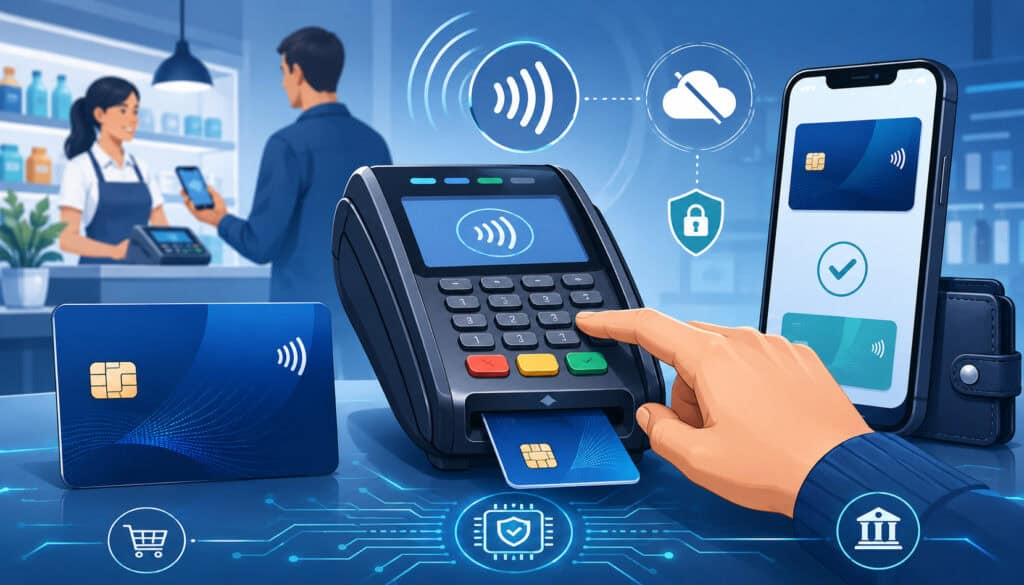
Offline EMV transactions require particular care because EMV’s local card-terminal capabilities should not be confused with terminal store-and-forward.
EMV contact-chip technology uses interactions between the chip card and acceptance device to support secure payment processing.
The actual behavior depends on card application parameters, terminal capabilities, issuer configuration, cardholder verification, and payment-network requirements. EMVCo provides specifications and product approval processes for this ecosystem.
For merchants wanting more background on chip terminal operation, EMV-Compliant Terminals: Everything You Need to Know discusses EMV acceptance, terminal connectivity, and device considerations.
Contactless cards and mobile wallets introduce additional variables. A tap transaction may use a contactless card application or a network-tokenized credential from a consumer device. Merchants should not assume that a payment terminal offline transaction that works for an inserted chip card will also work for a contactless card or mobile wallet.
PIN debit may be even more dependent on real-time online authorization and network routing. Store-and-forward support for PIN-based transactions is not universal, and offline PIN capability in a card/terminal environment is not the same concept as postponing debit authorization.
The operational rule is straightforward: verify supported entry methods and transaction types with the processor rather than guessing based on the terminal’s hardware.
Card-Not-Present Payments and Why Merchants Should Never Write Card Numbers Down
Card-not-present transactions have different authentication and fraud characteristics from a normal card-present sale. Ecommerce transactions, virtual-terminal transactions, telephone orders, and manually keyed payments often depend heavily on online services and processor-specific controls.
Although network specifications can accommodate certain deferred authorization scenarios, that does not make improvised offline card-not-present collection a safe outage procedure.
Visa’s deferred-authorization documentation, for example, addresses both card-present and card-absent environments under defined network requirements rather than authorizing merchants to create their own storage methods.
Most importantly, never respond to an outage by writing sensitive card information on paper, in a spreadsheet, in a phone note, in email, or on an unsecured device.
Do not manually record:
- full payment card numbers for later entry;
- CVV, CVC, CID, or other card-validation codes;
- PINs or PIN blocks;
- full magnetic-stripe or equivalent track data.
PCI Security Standards Council guidance makes clear that card data storage must be tightly controlled and that sensitive authentication data such as card-validation codes and PIN/PIN blocks must not be stored after authorization. It also emphasizes minimizing payment-card data storage and protecting stored PAN where storage is legitimately required.
Use the processor’s approved offline function instead of creating a shadow payment database during an outage.
Does Store-and-Forward Cost More?
Sometimes, but not necessarily through a line item called an “offline fee.”
The financial effect of store-and-forward credit card transactions can come from several places. A processor or platform may have pricing associated with specialized transaction handling.
Authorization timing or processing characteristics may affect transaction qualification in certain environments. Network rules may also attach financial consequences to processing that does not meet required authorization, reversal, or clearing procedures.
Visa, for example, documents processing-integrity considerations associated with authorization and reversal practices. Exact costs and applicability depend on the transaction and merchant arrangement. Mastercard likewise maintains detailed processing rules governing authorization and deferred-authorization procedures.
But the biggest offline cost may not be a fee at all.
A useful way to think about it is:
Effective Offline Cost = Direct Processing Costs + Declined Transaction Losses + Fraud/Chargeback Losses + Labor/Reconciliation Cost
Suppose a mobile vendor stores 40 transactions with an illustrative average ticket of $45. The queued sales total $1,800. If three transactions totaling $155 later decline and cannot be collected, the merchant’s immediate economic loss from those sales is $155, before considering any applicable processing charges, disputes, staff time, or reconciliation work.
Those figures are purely hypothetical. The point is that even inexpensive offline functionality can become costly when decline rates or ticket sizes increase.
Reconnect and Upload Payments Safely
When connectivity returns, merchants should focus on completing the pending transaction upload before creating new problems.
A practical workflow is:
- Confirm that the terminal has re-established its approved secure connection.
- Allow the payment application to process its existing terminal transaction queue.
- Do not automatically re-enter pending sales.
- Monitor each upload result.
- Separate approvals from declines, communication failures, duplicates, or items still pending.
- Follow approved support procedures for exceptions.
- Confirm that successfully processed transactions appear in the appropriate batch or settlement reporting.
- Reconcile the uploaded queue to the POS sales records.
Status names vary by platform. A merchant may see terms such as pending, transmitting, approved, declined, duplicate, failed, retrying, completed, or uploaded. Employees should use processor documentation to determine exactly what each status means.
Merchants should upload stored transactions as soon as practical once service is restored and comply with applicable processor, acquirer, and network requirements. There is no safe universal rule such as “every terminal can store payments for three days.”
Network requirements can impose transaction-specific timing rules, and processor settings may be more restrictive. Visa’s deferred-authorization guidance is an example of why specific timing requirements cannot be generalized across all transactions and payment systems.
What Happens If the Terminal Stays Offline Too Long?
Remaining in offline mode longer than necessary increases both payment exposure and operational complexity.
First, the merchant continues exchanging goods and services for payment requests that may not yet have been authorized. The amount at risk grows with every additional offline sale.
Second, delayed transaction processing can run into network, acquirer, processor, or application timing requirements. Merchants should not assume an offline record can sit indefinitely and later process normally.
Third, terminal or application storage is finite. The exact number of transactions a device can hold varies, and merchants should not rely on an assumed capacity. A full queue could prevent further offline transactions or create operational exceptions.
Fourth, reporting becomes harder. Sales were made at one time, uploaded at another, may enter a later batch, and may fund on yet another date. Without reliable transaction identifiers and timestamps, accounting discrepancies become difficult to investigate.
Finally, long outages make fraud controls less responsive. If a merchant sees an unusual burst of expensive transactions but cannot obtain issuer decisions, exposure can accumulate quickly.
Businesses operating routinely in weak-connectivity environments should therefore prioritize merchant connectivity backup instead of making offline mode their primary architecture.
Avoiding Duplicate Charges, Batch Problems, Refund Errors, and Failed Uploads
A common mistake after reconnection is rerunning a transaction because the merchant does not immediately see it in the processor portal.
That can create duplicate charges. Before reprocessing anything, check the terminal’s history, local transaction ID, payment application, pending queue, and processor reporting. If the status remains uncertain, follow the approved support process.
Batch close and transaction upload are also not the same thing. Depending on the terminal and processor, a batch may contain successfully processed transactions while some offline records remain unresolved. Merchants should determine whether every queued item has actually been uploaded before treating a batch close as proof that offline processing is complete.
Refunds require similar caution. Generally, a merchant should first verify that the original transaction was actually processed before attempting to refund it. Refunding a transaction that never completed can create accounting confusion or an unintended financial result.
A void generally stops or cancels a transaction before final settlement under the applicable processing workflow, while a refund sends value back after a completed sale. A reversal can communicate that an authorization is no longer needed or needs adjustment.
Exact functionality varies by processor and transaction state; Visa separately documents authorization reversals as part of authorization management.
If a payment upload fails, check connectivity, processor service status, terminal/application status, and the pending queue before taking further action. Do not repeatedly resubmit blindly.
Offline Transaction Settlement and End-of-Day Reconciliation
Offline transaction settlement begins only after the stored record successfully moves into the required payment-processing flow.
A useful mental model is:
Stored Transaction → Upload → Authorization/Processing → Capture/Clearing → Settlement → Merchant Funding
Storing a transaction does not equal settlement, and settlement does not necessarily equal a same-day bank deposit. Merchant funding follows the processor or acquirer’s funding arrangements and can occur after network settlement and internal processing.
A strong end-of-day reconciliation flow is:
POS Sales → Online Transactions + Offline Queue → Uploaded Transactions → Declines/Exceptions → Batch → Settlement → Bank Deposit
For every offline transaction, the merchant should be able to associate the local sale with its eventual payment outcome.
| Field | Why It Matters |
| Local transaction ID | Connects the offline record to the POS sale |
| Terminal ID | Identifies the originating device |
| Transaction time | Shows when the customer made the purchase |
| Upload time | Shows when processing resumed |
| Amount | Supports sales reconciliation |
| Upload status | Identifies pending or failed items |
| Authorization result | Distinguishes approvals from declines |
| Batch ID | Links the payment to processing reports |
| Settlement status | Confirms downstream completion |
Merchants should investigate differences instead of assuming the bank deposit will exactly equal gross POS sales. Refunds, fees, chargebacks, delayed offline transactions, batching schedules, and other adjustments can affect the amount and timing.
Handling Declined Transactions After Upload
A decline after the customer has departed is an operational loss event, not an invitation to keep submitting the same transaction until it eventually approves.
A reasonable workflow is:
- Identify the exact original transaction and local transaction ID.
- Confirm the final processor status.
- Determine whether the response represents an issuer decline, communication failure, duplicate, or another exception.
- Do not repeatedly resubmit a declined transaction without authorization or processor guidance.
- If legitimate customer contact information is already available, use normal, lawful collection practices where appropriate.
- Document the transaction’s disposition.
- Update accounting records to reflect any uncollectible amount.
- Review whether offline controls should be adjusted.
The distinction between a decline and a payment upload failure is essential. A network timeout or communication error may mean the authorization result is unknown, while an issuer decline indicates that an authorization decision was returned.
A merchant also should not automatically charge a different credential on file or rebill a customer unless the merchant has appropriate authorization to do so. Store-and-forward does not create a blanket right to perform repeated billing attempts.
Recurring declines should trigger a risk review. The solution may be lower offline transaction limits, shorter offline periods, tighter eligibility controls, stronger connectivity redundancy, or avoiding offline processing for certain products.
Connectivity Redundancy Is Usually Better Than Accumulating Offline Risk
Store-and-forward is valuable because no communications system is perfect. But the strongest business-continuity strategy often combines offline capability with redundant connectivity.
Possible backup paths include:
- wired Ethernet;
- primary Wi-Fi;
- a cellular-enabled terminal;
- an approved mobile hotspot;
- a secondary carrier or connectivity service;
- a backup terminal using a different approved connection;
- processor-approved offline processing as the final fallback.
| Fallback Method | Advantage | Limitation |
| Backup Wi-Fi | Fast switch when primary network fails | May share the same ISP failure |
| Cellular terminal | Independent from local wired internet | Coverage can be weak or congested |
| Mobile hotspot | Flexible temporary connection | Security and processor approval matter |
| Secondary terminal | Adds device and connectivity resilience | More equipment and management |
| Store-and-forward | Can preserve sales when connectivity is unavailable | Merchant may accept decline risk |
Businesses shopping for hardware can review how credit card terminals work for a broader overview of countertop, wireless, mobile, virtual, and connected terminal environments.
The objective is not to eliminate every outage. It is to prevent a minor local connection failure from forcing the merchant into hours of uncontrolled deferred authorization.
Offline Risk for Restaurants, Retailers, Events, Field Services, and Hospitality
The appropriate use of offline mode changes by business model.
Restaurants can face complicated workflows involving open tabs, gratuities, delayed adjustments, split checks, and customers leaving soon after payment. A busy connectivity outage can create a large transaction queue quickly.
Staff should know whether the POS can safely associate tips and final amounts with stored payment records and whether the processor supports that workflow.
Retail stores may process large numbers of payments during an outage. Routine low-value items may be manageable under approved controls, while high-ticket merchandise creates much greater loss exposure. Retail operations also need strong duplicate prevention because customers may retry cards at multiple registers.
Farmers markets, fairs, festivals, and mobile events are natural use cases for store-and-forward because cellular networks can become congested. At the same time, customers are transient. Once the event customer walks away, collecting a later decline can be difficult.
Field-service businesses encounter similar issues in basements, rural properties, construction sites, and locations with poor signal. Technicians should understand when they may use offline processing and when a higher-value job should wait for connectivity.
Hotels and hospitality businesses have additional complexity because they commonly use estimated authorizations, deposits, incremental authorizations, and final charges.
Visa’s merchant authorization guidance specifically addresses estimated and incremental authorization workflows, reinforcing why lodging payments should not be treated like simple retail sales during an outage.
Security, PCI Considerations, Power Loss, and Device Theft
Offline functionality does not remove payment-security obligations.
Approved store-and-forward implementations should secure payment information according to the applicable terminal, processor, payment-application, PCI, and network requirements. Merchants should rely on supported encrypted storage and transmission rather than creating their own copies of card data.
PCI Security Standards Council guidance emphasizes minimizing stored cardholder data and protecting information when storage is legitimately necessary. It also prohibits storing certain sensitive authentication data after authorization, including card-verification codes and PIN/PIN blocks.
Physical device security matters too. PCI-approved terminal security documentation emphasizes secure terminal handling, resistance to tampering, and procedures for compromised devices.
A published Verifone PCI PTS security policy, for example, instructs merchants to remove a terminal from service if it is found in a tampered state rather than continuing to process payments.
If a terminal containing pending transactions is stolen, lost, or suspected of tampering, merchants should follow their incident-response procedures and promptly contact their processor or terminal provider. Do not attempt to extract stored payment records manually.
Power failures are similarly device-specific. Some devices preserve queued records safely; others have different recovery behavior. Use approved charging, battery-management, restart, and recovery procedures rather than repeated resets or unauthorized device modifications.
Fraud Controls and Staff Training for Terminal Offline Mode
Offline processing policies are only effective if front-line employees understand them.
Staff should know that offline does not automatically mean approved. They should understand the merchant’s approved transaction limits, which payment methods are eligible, when to refuse or postpone a suspicious or unusually large transaction, how to identify pending transactions, and when to escalate an outage.
Useful defensive controls can include:
- conservative per-transaction limits;
- aggregate offline exposure controls;
- short offline durations;
- transaction-velocity monitoring;
- restricting certain high-risk payment types;
- reviewing uploaded declines promptly;
- limiting which employees may enable offline workflows;
- maintaining secure custody of terminals;
- monitoring the offline queue during extended outages.
Employees also need a customer communication script that accurately describes the situation. For example, staff can explain that the payment system is experiencing connectivity problems and that only approved fallback methods are currently available. They should not falsely state that a stored transaction has received bank approval.
Training must include prohibited behavior as well. Employees should never record full card details, CVV, PIN information, or magnetic-stripe data on paper or personal devices. They also should not explore service menus, change risk settings, disable security controls, or repeatedly retry declines.
Common Store-and-Forward Mistakes
Most offline-processing losses come from operational misunderstanding rather than the mere existence of the feature.
Common mistakes include:
- assuming stored means approved;
- enabling offline processing without processor authorization;
- accepting unusually high-ticket sales during an outage;
- staying offline after connectivity becomes available;
- ignoring the pending queue;
- rerunning transactions and creating duplicates;
- assuming every card type, wallet, or debit transaction supports offline mode;
- writing card data down for later entry;
- failing to reconcile declined uploads;
- assuming offline processing has no additional economic cost;
- closing a batch without confirming how pending records are handled;
- confusing authorization with settlement;
- treating a communication failure as an issuer decline;
- attempting refunds before verifying that the original transaction completed;
- resetting or tampering with a terminal that displays a security error.
A particularly serious mistake is treating a tamper alert like a connectivity issue. A device reporting a security problem should be handled according to the manufacturer’s and processor’s incident procedures, not placed into offline mode to keep processing.
Merchants should also avoid undocumented workarounds shared between locations. An operating method that is appropriate for one processor, merchant account, terminal configuration, or transaction type may be unsupported somewhere else.
Store-and-Forward Risk Checklist
Before using payment terminal store and forward, verify each of these areas.
| Area | What to Verify |
| Processor supports offline mode | Confirm the merchant account is enabled |
| Terminal supports it | Confirm approved device/application capability |
| Eligible transaction types | Card types, entry methods, debit, wallets, CNP |
| Per-transaction limit | Merchant-specific approved control |
| Aggregate exposure | Maximum acceptable queued value |
| Maximum offline duration | Processor/network/device requirements |
| Fraud controls | Velocity and transaction restrictions |
| Connectivity backup | Wi-Fi, Ethernet, cellular, secondary path |
| Upload procedure | Automatic or operator-managed |
| Duplicate prevention | How pending records are identified |
| Settlement reporting | How uploaded transactions appear |
| Staff training | Roles, limits, escalation, prohibited actions |
The purpose of the checklist is not to create universal settings. It is to make sure the business knows its own approved settings.
A merchant that cannot answer these questions should consider offline processing unconfigured until the processor or terminal provider supplies the necessary information.
Questions to Ask Your Processor or Terminal Provider
A processor or terminal provider should be able to explain the specific implementation attached to the merchant’s account. Useful questions include:
- Does this exact terminal and payment application support store-and-forward?
- Which transaction types are eligible?
- Does the terminal obtain any authorization at checkout, or is authorization deferred until upload?
- Who bears the financial loss if a transaction later declines?
- Are there merchant-specific per-transaction or aggregate offline limits?
- How long may transactions remain pending under our configuration?
- Can additional processor or network fees apply?
- Can offline processing affect interchange qualification or other transaction economics?
- Are contactless cards supported?
- Are network-tokenized mobile-wallet transactions supported?
- Can PIN debit be processed when normal connectivity is unavailable?
- How does the terminal display failed uploads and issuer declines?
- How are duplicate transactions detected or prevented?
- What happens to the offline queue after a power loss?
- How do uploaded payments appear in batches and settlement reports?
- What is the approved recovery procedure if transactions remain stuck?
- Which support channel should staff contact during a prolonged outage?
Document the answers in operating procedures rather than relying on employee memory.
Frequently Asked Questions
What is store-and-forward payment processing?
Store-and-forward payment processing allows an approved payment system to capture an eligible transaction during a connectivity problem, store it temporarily, and transmit it after communications return.
Depending on the implementation, issuer authorization may not occur until that later transmission. Merchants therefore should treat the transaction as unresolved until its actual processing result is known.
How does offline credit card processing work?
A terminal or payment application detects that normal connectivity is unavailable and, if offline functionality is enabled and the transaction is eligible, places the payment record into secure temporary storage. When the connection returns, the system uploads the transaction for the required authorization or processing steps.
Is an offline card transaction actually approved?
Not necessarily. A locally stored or accepted transaction may not have reached the issuer. The terminal’s message should be interpreted according to processor documentation. Unless real authorization has occurred, merchants should not represent a stored payment as issuer-approved.
Can an offline transaction decline after the customer leaves?
Yes. If authorization was deferred, the issuer can return a decline after upload. By that time, the customer may already have received the goods or services, which is the central financial risk of store-and-forward.
Who pays when an offline transaction later declines?
There is no universal answer. Responsibility depends on the merchant agreement, acquirer and processor terms, payment-network requirements, transaction circumstances, and whether required procedures were followed. Merchants should specifically confirm their exposure with their processor.
Does store-and-forward cost more?
It can. Extra costs may include processor or network charges where applicable, differences in transaction economics, decline losses, fraud or chargeback exposure, and additional labor. Merchants should not assume that every processor charges a specific “offline fee.”
How long can a terminal hold offline transactions?
There is no universal storage period. Limits can depend on the device, processor, network, merchant configuration, transaction type, and applicable authorization requirements. Merchants should upload as soon as practical after connectivity returns and follow their processor’s instructions.
What happens when a terminal reconnects?
The terminal or payment application should transmit eligible queued records according to its approved workflow. Merchants should then monitor authorization and processing results, identify declines or failures, confirm successful transactions in reporting, and reconcile them to the original POS sales.
Can EMV chip cards be processed offline?
Some EMV environments support offline capabilities, but EMV card-terminal decisioning and store-and-forward are different mechanisms.
Actual behavior depends on the card, terminal, issuer parameters, payment application, network, and processor configuration. Merchants should never assume all chip cards qualify for offline processing.
Can contactless cards or mobile wallets work offline?
Possibly, depending on the solution. Contactless cards and mobile wallets can use different applications and credentials, including network tokens. Support for one payment method does not establish support for another. Verify each entry method with the processor.
Can PIN debit be processed in offline mode?
Not universally. PIN debit and other online-debit transactions can depend on real-time authorization and specific network routing. Merchants should treat offline PIN-debit capability as processor- and network-specific rather than an expected terminal feature.
How do merchants avoid duplicate charges after reconnection?
Do not immediately rerun every payment. First check the terminal history, local transaction ID, pending queue, POS record, and processor status. If the outcome remains unclear, follow the approved support procedure before submitting another transaction.
What happens if a pending transaction fails to upload?
Determine whether the problem is connectivity, a processor outage, device status, a duplicate response, or another processing exception. Keep the original transaction record intact and use processor-approved troubleshooting. Avoid repeated blind submission.
When should merchants avoid store-and-forward?
Avoid it when the payment type is unsupported, the transaction is suspicious or unusually large, the outage is becoming prolonged, the merchant cannot absorb a possible loss, the processor has not enabled offline processing, or the terminal is showing a security or tamper problem rather than a connection failure.
How should offline transactions be reconciled?
Match each local transaction ID and amount to its upload status, authorization result, batch record, settlement record, and eventual merchant funding. Investigate declines, duplicates, unresolved transactions, and timing differences instead of reconciling only against the day’s gross POS total.
Conclusion
Store-and-forward can be an effective payment-continuity tool, especially for retailers, restaurants, field-service companies, mobile businesses, and event vendors that occasionally encounter unreliable internet or cellular coverage. It allows eligible payments to be held temporarily instead of bringing commerce to an immediate stop.
The benefit comes with a fundamental risk: a stored transaction may not yet be authorized. If the authorization occurs only after connectivity returns, the issuer can still decline the payment after the customer has left.
Merchants should therefore treat offline mode as a limited, processor-approved fallback backed by conservative risk controls.
Confirm transaction eligibility, offline limits, aggregate exposure, applicable timing requirements, fee implications, EMV and contactless behavior, debit restrictions, upload procedures, duplicate controls, settlement reporting, security requirements, and responsibility for losses before an outage occurs.
Strong connectivity redundancy should remain the first line of defense. Store-and-forward becomes most useful when Ethernet, Wi-Fi, cellular, or another approved path is temporarily unavailable—not when it replaces reliable payment communications as a normal operating model.
Above all, keep authorization, storage, clearing, settlement, and funding distinct. A terminal saying that it stored a transaction does not mean the issuer approved it, and a transaction sitting in an offline queue is not the same as money in the merchant’s bank account.
Informational disclaimer: This article provides general educational information about payment-terminal operations and payment processing. Network rules, processor requirements, terminal capabilities, merchant agreements, security standards, fees, transaction eligibility, authorization procedures, liability, and settlement practices vary and can change.
Merchants should rely on their current processor/acquirer agreement, terminal documentation, applicable payment-network rules, and PCI requirements for operational decisions.